
From Then to Now (Part 1: St. Stan’s)
In my first blog episode (September 7, 2026), I explained the early roots of my love for astronomy and for imagining stories. The next few episodes will follow my path toward a career in astronomy, including my first dabbles at creative writing. The specific story of the novel itself will emerge a few episodes later.
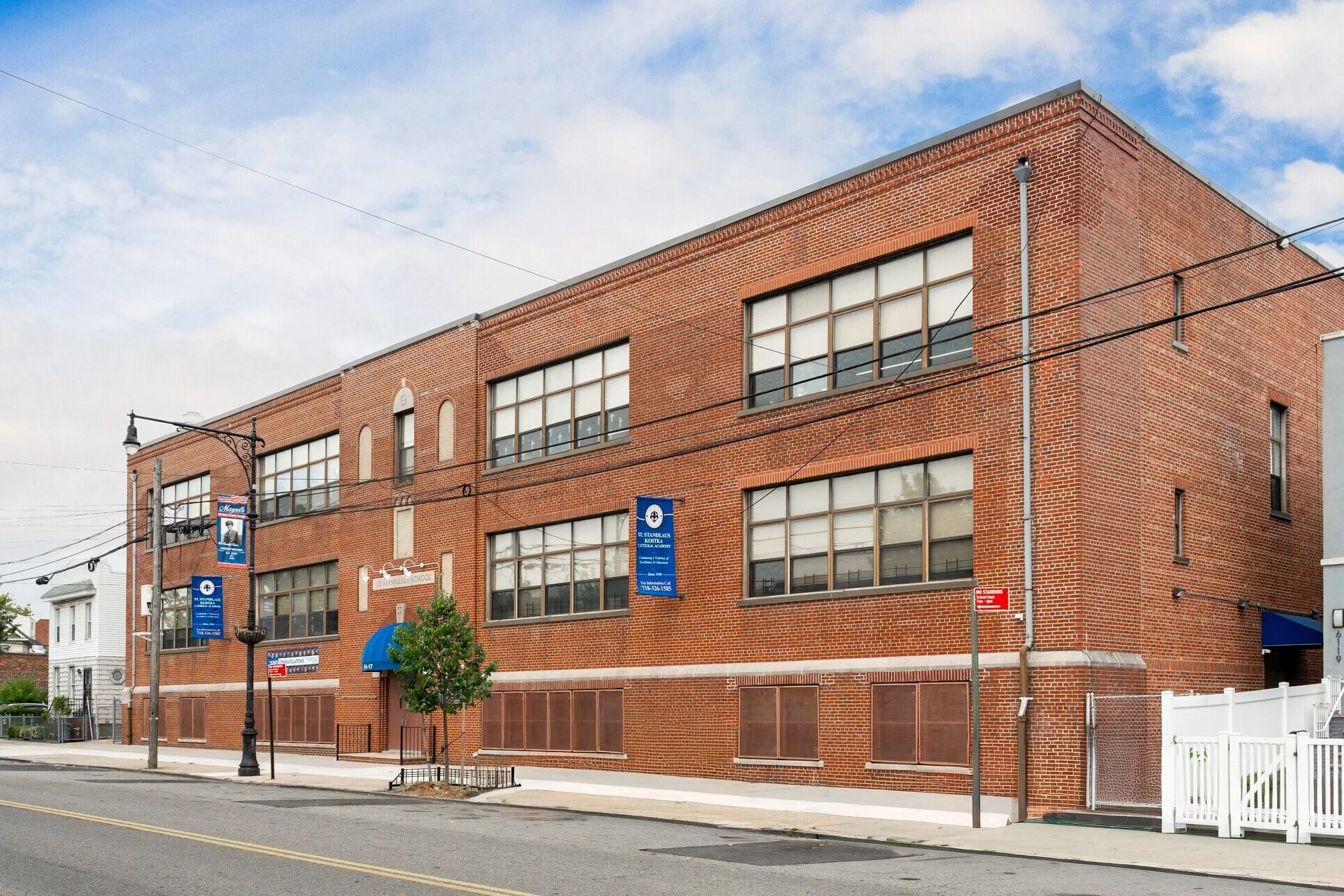
St. Stanislaus Kostka Catholic Academy, Maspeth, NY.
In 1952, I was enrolled in St. Stanislaus Kostka School, or “St. Stan’s Slaughterhouse” as we used to call it. St. Stan’s, located in Maspeth Queens NYC, got renamed St. Stanislaus Kostka Catholic Academy of Queens in 2010. Back in the 50s, it was a diocesan grammar school covering first through eighth grades taught by the Sisters of St. Joseph. The picture accompanying this blog is the modern “academy”, but St. Stan’s hasn’t changed much on the outside. Although cleaner, with nicer curb appeal and new windows, it always was and still is just a big brick box surrounded by concrete. Back in the 50s, the students were predominantly from blue-collar Irish, German, Italian, and Eastern European families, usually not too far removed from their immigrant roots. The children are more diverse today and are taught by lay professionals, not nuns.
Even by 1952, I was so smitten by astronomy and science that I was actually shocked when I first entered a St. Stan’s classroom. Why? Because there were no lab tables, racks of test tubes, or science equipment, just ancient wooden desks bolted to the floor, with inkwells! I swallowed the disappointment and applied myself. Once I was able to read my uncle’s old astronomy books in the upper grades (see my first blog episode), astronomy had became permanently woven into my identity. By the end of my time at St. Stan’s, I somehow learned that a typical astronomer has a Doctor of Philosophy degree, which usually requires not just four years of high school and four years of college but also many additional years of graduate school. All the schools had to be the best to guarantee success. Who could afford that? Not me.
While my home life felt comfortable enough, we were definitely not “well off”. We lived in a run-down rental on a scruffy cul-de-sac and did not even own a car. Other children considered my home a dump. The tank of vinegar on top of the pickled pigs’ feet factory across the street often spiced up the atmosphere, but the air smelled positively gross when an unfavorable wind swept our way from the infamous Newtown Creek, an industrial waterway flanked by refineries between Queens and Brooklyn.
My street had the nickname “Nanny Goat Hill” because it was once the site of a farmstead with goats. Most of the old hill had been cut away leaving a huge vacant lot full of dirt, rocks, spiders, and a generous patina of broken glass, ripe for afternoon exploring by unsupervised children. I recall standing there in a circle of kids as the older ones threw rocks at a bullet sitting on a boulder. Thankfully it did not go off. There was always talk of some teenagers having “zip guns”, but I never saw one. It was an age of innocence compared with today. Our house was built into the top of the remaining part of Nanny Goat Hill. After a snowstorm, the street on our side of the hill resembled a bunny slope. Kids in huge numbers gathered outside our house for the best sledding in the neighborhood. The other, cutaway side of the hill dropped precipitously. Amazingly, no barrier or warning sign demarcated the end of the street. So, one night, a carful of drunk teenagers drove over the edge. Supposedly, no one got injured, but, thinking back on it, I find that hard to believe.
Our combination kitchen and dining room occupied half of the bottom level of the house. I grew up thinking it natural to have a décor of water pipes and utility meters while dining. The other half of the ground level was what we called the basement, an unfinished storage and utility area walled off from the kitchen except for a door kept mercifully closed. I say mercifully because it had lots of shadowed corners harboring real creepy crawlies and imagined monsters. A huge dormant red cast-iron coal furnace commanded the center. Its multi-armed ductwork went everywhere in a thick tangle, and the grill of the burn chamber door looked like teeth. I had not thought of it before writing this blog, but the furnace might subconsciously have influenced Mahakala’s appearance as a red Giant Pacific Octopus in my novel. Several of my worst childhood nightmares involved that basement.
By the way, you might think that I could not see enough of the night sky to sustain a passion for astronomy while growing up in New York City. On the contrary, in the 50s, I could often pick out “Deep Sky” objects from my backyard like the Orion Nebula, the Andromeda Galaxy, and the Hercules Globular Cluster with my naked eyes. Light pollution in modern times is so bad that I can’t even do that in Bloomington Indiana. Here and now, I am lucky to see the Milky Way once in a great while. I don’t think humans understand how much their psyches suffer from being cut off from visions of the Universe.
But I digress. The realization of my family’s low economic status and its implications for becoming a professional astronomer hit me hard. The moment stands out in my memory. I was in our small make-shift living room on the second floor, where we watched Ed Sullivan and Jackie Gleason. Bright sunshine beamed through the windows like a cosmic exclamation point. I resolved then to do so well in school that I would earn scholarships to pay for all the education I needed. The Space Race launched by the Cold War eventually supported these lofty ambitions, but in eighth grade it did not solve the problem of what high school I’d attend, the necessary first step toward my Ph.D.
Among the free public high schools in NYC at the time, the premier choice for science would have been Bronx High School of Science, but it was just too long a commute from where we lived. The more accessible Brooklyn Tech was not as top notch. My Catholic grammar school, of course, promoted Catholic high schools, but tuitions at the best of these would have stressed my family. The long shot for me was to win entrance to Regis High School, an elite, heavily endowed, Jesuit-run institution in Manhattan. Each year, Regis chose a class of about 150-200 boys from Catholic grammar schools around the metropolitan area. The chosen attended cost free, typically only about one from each competing primary school. It was a long shot. Honestly, I did not expect to get in, because the entrance exam was brutally hard. I remember sitting at a desk at Regis, No. 2 pencil in hand. I’ve forgotten all the specific questions, but the test resembled a college SAT. As it turned out, I was the student chosen from St. Stan’s in my graduating year. I was ecstatic but scared. Regis had and continues to have a well-deserved reputation as an outstanding but demanding school. The astute reader will recognize Regis High School as Dr. Anthony Fauci’s Alma Mater. We just missed overlapping. He graduated in Spring 1959; I entered in Fall 1959.